UK Salary Calculator: Work Out Your Take-Home Pay
This UK salary calculator shows your take-home pay after income tax, National Insurance, pension, and student loan deductions. It runs on the current 2026/27 tax bands, applies the correct rates for Scotland and the rest of the UK, and gives your net pay by year, month, week, or day.
- Scotland & rest of UK
- Pension & student loans
- Compare two salaries
- See a worked example
HMRC rates for 2026/27 (2025/26 also available), checked against GOV.UK on 8 October 2026. For guidance only.
Step by step
How to Use This Salary Calculator
You don't need a finance degree to calculate salary deductions here. Follow these steps for a number in seconds.
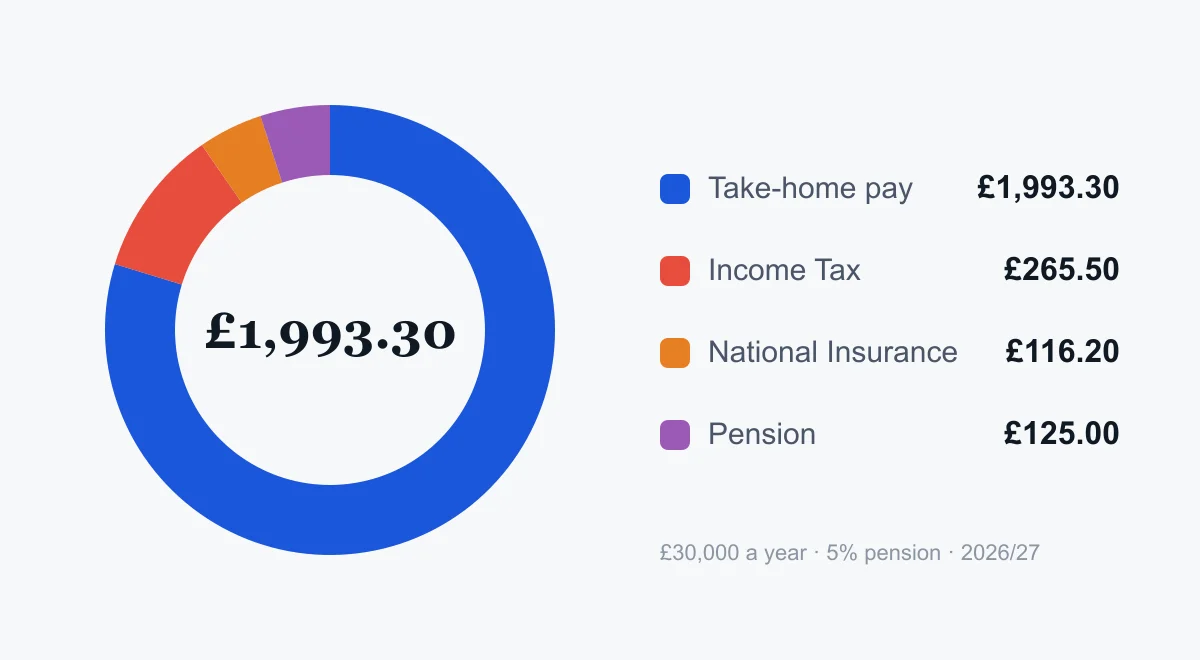
Basic Steps for a Monthly Salary Calculation
- 01
Enter your salary
Type your gross salary in the salary box.
- 02
Pick a pay frequency
Set it to “Monthly”, or enter your annual figure and switch the results tab to Monthly after.
- 03
Click “Calculate”
The results panel opens straight away.
- 04
Read your results
See your take-home pay, income tax, and National Insurance.
That's the whole flow for a basic income salary calculator. No tax code, no pension, no student loan. Just a salary number in, and a take-home number out.
The Other Options, Briefly
A few extra fields turn this into a proper salary income calculator, not a rough guess. You don't have to fill them in. But each one sharpens the result:
- Tax codeAdd yours if you know it. The default assumes a standard allowance. Benefits, perks, or past underpayments can change it.
- Scotland checkboxTick this if you pay Scottish income tax. The bands switch right away.
- Pension %Your employee contribution. It usually comes off before tax.
- Pension typeNet pay, salary sacrifice, or relief at source. Salary sacrifice also lowers NI and student loan repayments.
- Student loan planPick your plan, and tick Postgraduate if you have one too. This shows your real repayment.
- Blind Person’s Allowance / No NITick either box only if it applies to you.
Compare mode
Comparing Two Salaries Side by Side
Sometimes you want to compare two numbers, not just see one. Switch to “Compare two salaries” at the top of the calculator. A second salary box appears next to the first.
Enter both gross salaries. Add tax code, pension, Scotland, and student loan settings for each, if they differ. Hit “Calculate”. You'll get a side-by-side breakdown: gross pay, tax, NI, pension, student loan, and take-home pay for both. The difference between them shows up, too.
Use this to weigh up a job offer against your current pay. Or see what a pay rise is worth once tax takes its share. Or check how a salary sacrifice pension changes your net pay. Two figures side by side tell you more than one number alone.
- 1Job offer vs current paySee the real monthly gain, not the headline one.
- 2Pay riseFind out what a raise is worth after tax and NI.
- 3Salary sacrificeCheck how swapping pay for pension changes take-home.
Monthly pay
Monthly Take-Home Pay Explained
Most people get paid monthly. This is the number most people care about. You might call it a monthly salary calculator, a monthly pay calculator, or a monthly wage calculator. The job is the same. It turns your annual salary into the amount that lands in your account each month. This UK monthly salary calculator handles any salary, any tax code, and any pension setup. You don't need to adjust anything by hand.
What a Monthly Income Calculator Shows You
A real monthly income calculator doesn't just divide your annual salary by twelve. Tax bands, National Insurance thresholds, and student loan repayments all work on a pay-period basis. That's why a flat division by twelve can drift from your real payslip.
This tool works as a monthly earnings calculator UK employees can use at any salary level. It works for entry-level pay and six-figure roles alike. Switch the period to “Monthly,” and it becomes a full monthly salary payment calculator. It shows gross pay, deductions, and net pay side by side.
Want a monthly take-home calculator that handles pensions and student loans, too? This does that. Add your pension percentage and loan plan. The monthly net pay calculator updates right away. No second tab needed for the student loan sums.
Monthly Net Pay, Step by Step
A monthly net salary calculator should show its working. It shouldn't just spit out a number. Here's the order your money moves in.
- 1Pensionif taken before tax
- 2Income taxafter your allowance
- 3National Insurance8% then 2%
- 4Student loanif you have one
- 5Take-home paywhat lands in your account
Pension comes first if it's deducted before tax. Then income tax. Then National Insurance. Then your student loan repayment, if you have one. What's left is your net monthly income calculator result. That's your real take-home pay for the month.
People search for a monthly wage calculator UK-wide for many reasons. Some want a take-home monthly pay calculator to plan a mortgage. Others want a net salary income calculator to check that their employer got it right. However you phrase it, monthly wage calculator, monthly take-home salary calculator, or salary calculator monthly take-home, you'll land on the same numbers here.
Does your job involve shifts or changing hours? You might want to see your monthly figure as an hourly rate, too. This helps before you agree to overtime or a part-time switch. You can convert your monthly pay into an hourly rate without entering your tax details again.
Pay frequency
Weekly Pay and Other Pay Frequencies
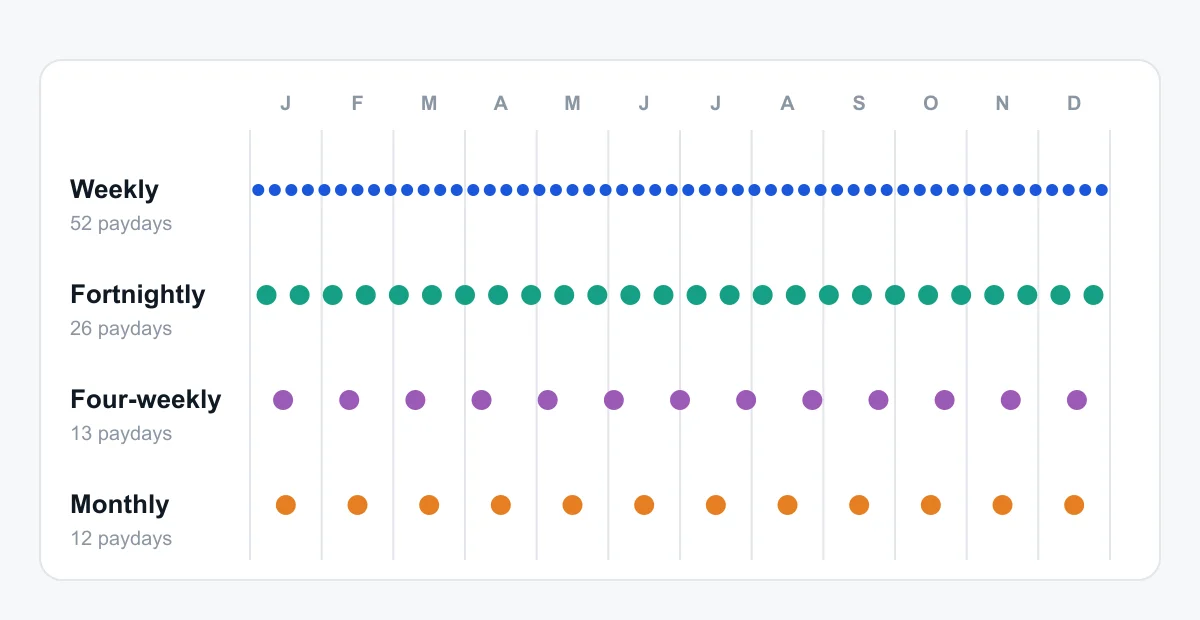
Not everyone gets paid monthly. On a weekly payroll? Switch the calculator to “Weekly”. It works the same way. It applies tax and National Insurance every week, not by splitting an annual figure by 52.
A weekly salary calculator matters more than people think. Tax and NI thresholds apply per pay period. Do your hours change from week to week? A weekly salary calculator UK shift workers and contractors use will catch those swings better than a flat annual estimate.
This also works as a UK weekly salary calculator for comparing pay types. Say a £600-a-week wage against a £31,200-a-year role. You can check if the take-home pay really differs once pay periods count. Often, it doesn't differ by much. But it's worth checking before you sign anything.
Some people want the opposite. A yearly pay calculator, which UK employers and staff both use, turns a daily or hourly rate into a full annual figure. Then you can work out monthly or weekly deductions from there. Pick whichever frequency matches your payslip. The rest falls into line on its own.
Same pay, two ways of quoting it
£600 × 52 weeks = £31,200
Annually
× 1
The figure on job adverts
Monthly
÷ 12
The most common UK payroll
Weekly
÷ 52
Thresholds applied every week
Daily
÷ 260
Five working days a week
Hourly
× your hours
Set your hours per week
Converting
Converting Annual Salary into Monthly Figures
Job adverts almost always quote an annual number. But you live your life monthly. Rent, bills, savings, all of it. That gap is what an annual-to-monthly salary calculator is for.
Type your yearly figure into the salary box. Choose “Annually” as the pay frequency. Then flick the results over to the monthly tab. That's it. You've just used a yearly-to-monthly salary calculator. No second tool needed. The same logic works in reverse, too. Got a monthly contract and need the bigger picture? This doubles as a monthly salary to annual calculator. Just enter your monthly figure and switch the frequency dropdown.
An annual monthly salary calculator like this one beats dividing by twelve in your head. Tax isn't that simple. Your personal allowance, the basic rate band, and the National Insurance thresholds are all set per year but applied per pay period. A true annual-to-monthly salary converter accounts for that. It doesn't guess. Use this as a monthly salary calculator from annual pay, and it saves you doing the maths twice.
Want to understand the difference properly first? Our piece on the real difference between gross pay and monthly take-home explains it without the jargon. Once that clicks, working out how to calculate monthly salary from annual salary stops feeling stressful. You'll spot a weak job offer, or a good one, much faster.
Deductions
Net Pay, Tax, and National Insurance: What's Actually Deducted
This is the part most calculators skip. So let's spell it out.
Income tax · England, Wales & NI
2026/27| Personal Allowance | Up to £12,570 | 0% |
|---|---|---|
| Basic rate | £12,571 to £50,270 | 20% |
| Higher rate | £50,271 to £125,140 | 40% |
| Additional rate | Over £125,140 | 45% |
Employee National Insurance
Class 1Monthly payslips use £1,048 and £4,189; weekly use £242 and £967.
Income tax uses your personal allowance first. That's £12,570 for most people in 2026/27. Then it applies in bands: 20% basic rate, 40% higher rate above £50,270, and 45% additional rate above £125,140. Scotland has its own bands. That's why this works as a separate salary calculator that England and Scotland users can both rely on. The numbers don't get mixed up.
National Insurance looks simple on paper. But it's easy to get wrong by hand. It's 8% on earnings between £12,570 and £50,270, then 2% above that. A real net wage calculator applies both correctly per pay period. It doesn't use a rough annual average.
Use it as a salary breakdown calculator. You'll see where each pound goes: tax, NI, pension, student loan, and what's left as net pay. That breakdown matters more than the headline figure. Two people on the same salary can take home different amounts. It comes down to their tax code, pension type, and student loan plan.
Searching for an after-tax salary calculator? Or a net salary income calculator? Or just a way to calculate the net salary on a new offer before you accept it? This does all of that. The same goes for anyone using a salary payment calculator to check a payslip, or a net salary UK calculator to compare two job offers.
For the official word on current thresholds, HMRC's income tax rates and allowances are published and updated every tax year. It's worth a glance if a number here ever looks off.
Every region
One UK Salary Calculator for Every Region
Tax rules aren't the same across the UK. A generic calculator salary UK tool that ignores that will quietly give you the wrong number if you live north of the border.
England, Wales & NI
Leave the Scotland box unticked
- Basic rate20%
- Higher rate40%
- Additional rate45%
Scotland
Tick the Scotland box · 2026/27 bands
- Starter rate19%
- Basic rate20%
- Intermediate rate21%
- Higher rate42%
- Advanced rate45%
- Top rate48%
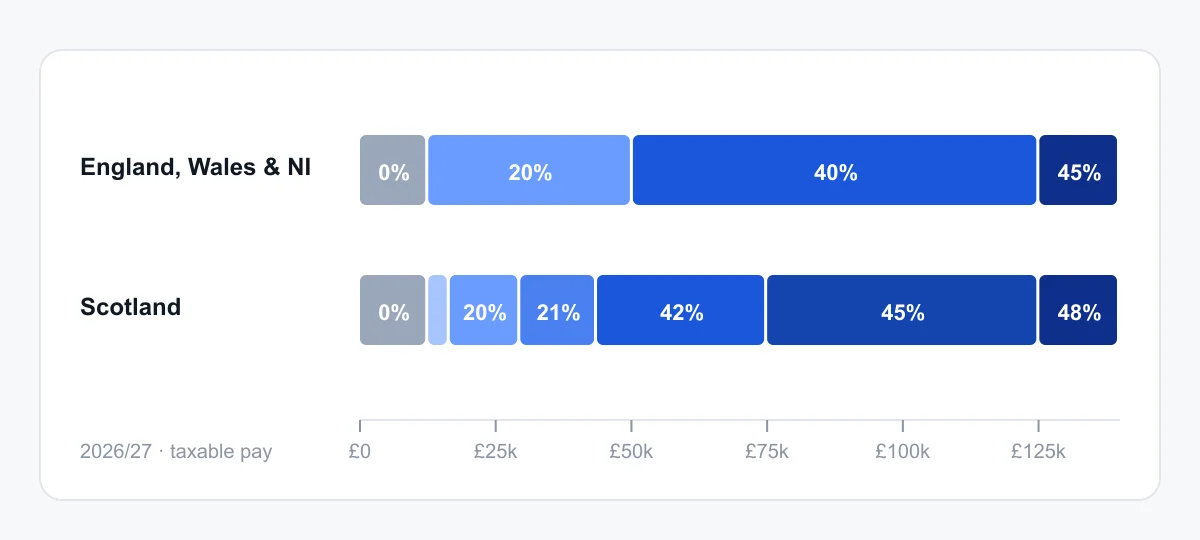
Tick the Scotland box and the calculator switches to the Scottish income tax bands right away. No separate spreadsheet needed. Leave it unticked, and it uses the rates for England, Wales, and Northern Ireland.
That's what makes this the UK salary calculator worth bookmarking. Not a one-off Google search you forget about by next payday. As a salary uk calculator, it handles every region correctly the first time. It's not an England-only tool with Scotland bolted on as an afterthought.
Real-world check
A Real Example: Why Your Payslip Might Not Match the Calculator
It's a common moment. You run your numbers through an online salary calculator. Then your first payslip lands, and the figures don't quite match. Don't panic. You're not doing anything wrong. It happens to a lot of people.
~£40
a month difference in take-home pay
~£13
difference in National Insurance
2
student loan plans on the same payslip
In one online discussion, someone on a £45,000 salary compared their numbers. They had a non-standard tax code, a 5% pension contribution, and two student loan repayment plans. Their calculator estimate and their real payslip were close, but not the same. Take-home pay was out by roughly £40 a month. National Insurance was off by about £13. Both student loan repayments came out slightly higher on the calculator than on the actual payslip.
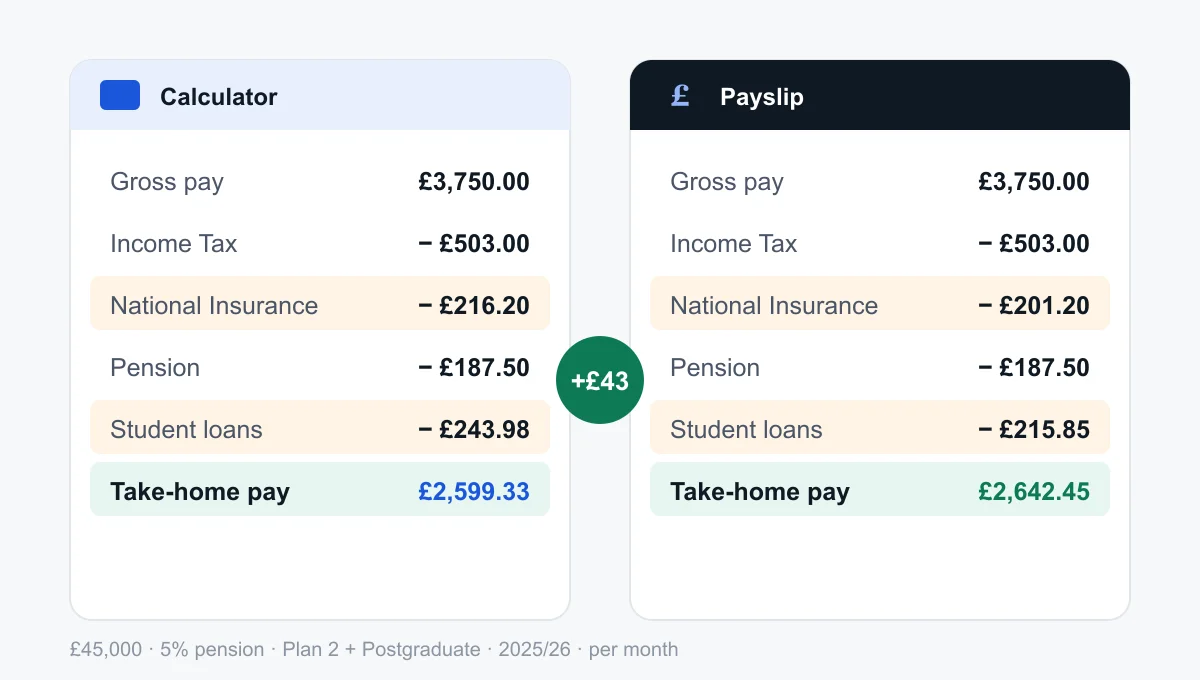
The fix turned out to be the pension structure, not the tax. Their employer ran auto-enrolment through salary sacrifice. Pension contributions came off gross pay before National Insurance and student loan repayments got worked out. The standard method takes pension off after, not before. Once that one setting got switched in the calculator, the numbers lined up. It's a good reminder that the small print on your pension scheme matters more than people expect.
It's also why so many people compare two or three calculators before they trust any of them. One online discussion about finding the best take-home pay calculator showed the same pattern: someone starting a new job tried several calculators and kept getting different results, even after working through the withholding by hand. Manual calculations tend to go wrong in the same spot. Usually, it's how the personal allowance or pension gets applied, not the tax rates themselves. The fix is almost always the same. Check whether your pension is a salary sacrifice, relief at source, or a net pay arrangement. That one detail shifts National Insurance, student loan repayments, and sometimes your effective tax rate, too.
Salary sacrifice
Comes off before tax, NI and student loan
Net pay arrangement
Comes off before tax only
Relief at source
Comes off after tax; your provider adds 20% relief
Worked example
A Quick Worked Example: £30,000 a Year
Numbers make more sense with a real example. Here's one using the current 2026/27 rates.
Say you earn £30,000 a year, paid monthly. No pension and no student loan, to keep things simple.
Your monthly gross pay is £2,500 (£30,000 ÷ 12). Your personal allowance is £12,570 a year, or £1,047.50 a month. That leaves £1,452.50 of your monthly pay as taxable.
Tax at the basic rate of 20% comes to £290.50. National Insurance, charged at 8% on earnings above the monthly threshold of £1,048, comes to £116.16. Add those together. Your total monthly deduction is £406.66.
Subtract that from your £2,500 gross. Your take-home pay lands at £2,093.34 a month.
Monthly payslip
£30,000 a year
- Gross pay
- £2,500.00
- Tax-free allowance
- £1,047.50
- Taxable pay
- £1,452.50
- Income tax at 20%
- − £290.50
- NI at 8% above £1,048
- − £116.16
- Take-home pay
- £2,093.34
Moving into a higher tax band doesn't tax your whole salary at the higher rate. Only the slice above the threshold gets taxed that way. The same staged logic applies to National Insurance. And if you earn over £100,000, your personal allowance starts shrinking by £1 for every £2 you earn above that. It disappears completely once you reach £125,140.
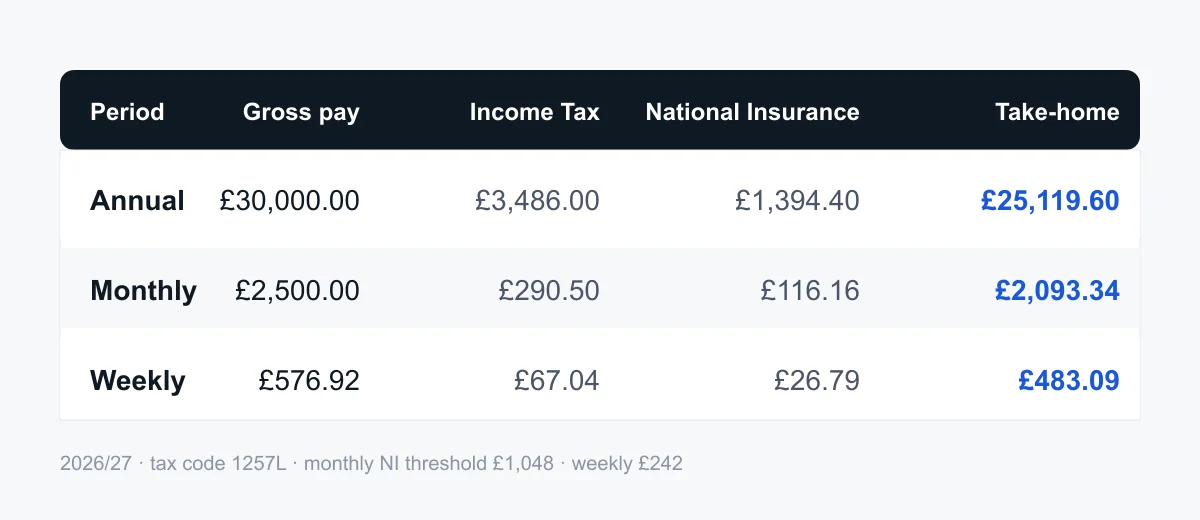
Add a pension contribution or a student loan repayment to that same £30,000, and those figures shift again. That's exactly why a calculator beats doing this by hand every time your circumstances change.
In short
Conclusion
A salary calculator is only useful if it matches reality. And reality in the UK means tax codes, pension structures, student loan plans, and different income tax bands depending on where you live. That's a lot to hold in your head every time you want a straight answer.
This tool handles all of it in one place. Check a job offer. Work out your monthly take-home pay. Compare a weekly wage. Or convert an annual salary into something you can budget against. It uses this year's rates, not last year's. It shows the full breakdown, not just a final number.
If your real payslip ever looks different, it's almost always one detail. Usually, it's your pension setup, not a fault with the maths. Check that first. The rest tends to fall into place.
How do I calculate monthly pay from an annual salary?
Enter your annual salary. Set the frequency to monthly. The calculator will calculate monthly pay using this year's tax bands, not a flat division by twelve. For a rough figure, dividing by 12 is fine. For anything involving tax, NI, or a student loan, let the tool do it properly instead.
Can I calculate monthly income, including a pension or student loan?
Yes. Open the extra details section. Add your pension percentage and select your student loan plan. It will calculate the monthly income net of both, alongside income tax and National Insurance.
What's the most accurate way to calculate a monthly salary after tax?
Use your real tax code, not the standard one. Benefits in kind, past underpayments, or other adjustments can shift your personal allowance up or down. Getting that detail right to calculate the monthly salary after tax matters more than people think.
Is this the same as a take-home monthly salary calculator?
Yes, that's exactly what it is. Search for a take-home monthly salary calculator, a monthly net pay calculator, or just calculate salary deductions quickly. You'll get the same figures here.
Does this work as a monthly salary calculator from annual pay?
Yes. Enter the annual figure. The results panel converts it right away. You're using a monthly salary calculator from annual pay, with no separate annual-to-monthly tool needed.
Does the calculator handle Scotland correctly?
Yes. Tick the Scotland box, and it switches to the Scottish income tax bands. Scotland has six bands, from a 19% starter rate to a 48% top rate, so the figures differ from the rest of the UK at most income levels.
Why is my real payslip slightly different from the calculator's figure?
Usually, it's the pension structure. Salary sacrifice pensions reduce National Insurance and student loan repayments more than standard auto-enrolment. That's because contributions come off your pay before those get calculated. Bonus months, mid-year pay rises, and unused tax allowances from earlier in the year can also create small differences.
Does it cover Plan 1, Plan 2, Plan 4, Plan 5, and Postgraduate student loans?
Yes, all current student loan plans are included. You can select more than one repayment type, too, if you have both an undergraduate and a postgraduate loan running at the same time.