Gross vs. Net Pay: Where Your UK Payslip Goes Before Payday
What separates gross pay from take-home pay in the UK, including Income Tax, National Insurance, workplace pension and student loan, with a worked payslip.
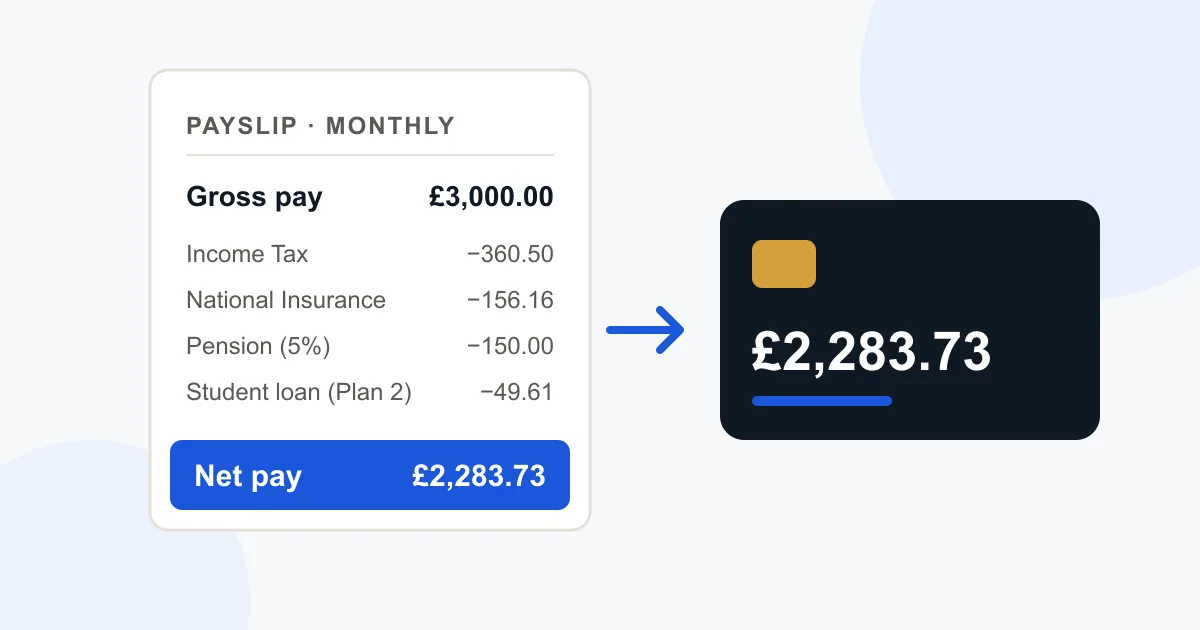
Gross pay is what you earn before anything is taken off: your salary, or your hours multiplied by your rate. Net pay is what is left after deductions, the amount that lands in your bank account. How big the gap is depends on your income, where you live, your pension and whether you have a student loan. In the worked example below, net pay comes to about 76% of gross.
This guide goes through each deduction in the order it usually appears on a UK payslip, then puts them together in an example.
What counts as gross pay
Gross pay includes everything your employer pays you for the period:
- Basic salary or hourly pay
- Overtime
- Bonuses and commission
- Shift allowances and other taxable payments
If you are not sure what your gross monthly pay is, our guide on calculating monthly salary from annual or hourly pay walks through it.
Income Tax
Income Tax is collected through PAYE (Pay As You Earn). Your employer uses your tax code to work out how much to take each payday.
Most people have a Personal Allowance of £12,570 a year, which is tax-free. The standard tax code, 1257L, reflects that allowance. In England, Wales and Northern Ireland, income above the allowance is taxed in bands for 2026/27:
| Band | Taxable income | Rate |
|---|---|---|
| Basic rate | £12,571 to £50,270 | 20% |
| Higher rate | £50,271 to £125,140 | 40% |
| Additional rate | Over £125,140 | 45% |
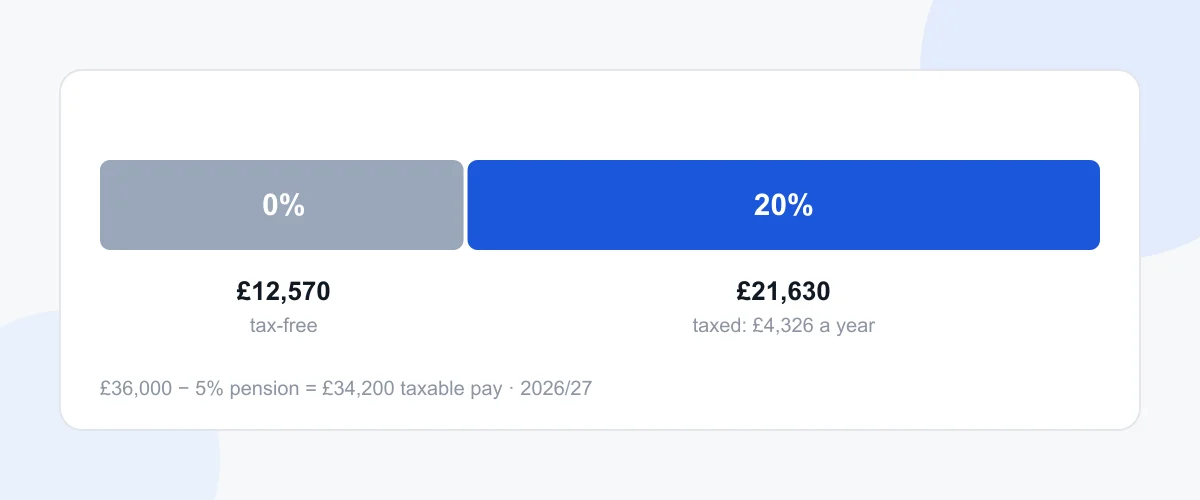
Only the slice of income inside each band is taxed at that band's rate. If you earn over £100,000, your Personal Allowance falls by £1 for every £2 above that, and disappears entirely at £125,140.
Scotland sets its own Income Tax bands, with six rates from 19% to 48%. If you live in Scotland, your tax code starts with an S.
National Insurance
Employees pay Class 1 National Insurance on earnings above the Primary Threshold:
- 8% on earnings between £12,570 and £50,270 a year
- 2% on earnings above £50,270
Unlike Income Tax, National Insurance is worked out separately for each pay period. On a monthly payslip the thresholds are £1,048 and £4,189; on a weekly payslip they are £242 and £967. You stop paying it once you reach State Pension age.
Workplace pension
If you are eligible, your employer must enrol you in a workplace pension. The legal minimum is 8% of your qualifying earnings in total, of which at least 3% comes from your employer and the rest from you. Qualifying earnings are the part of your pay between £6,240 and £50,270 a year. Many employers calculate contributions on your full salary instead, or pay more than the minimum.
How your contribution affects your payslip depends on how the scheme takes it:
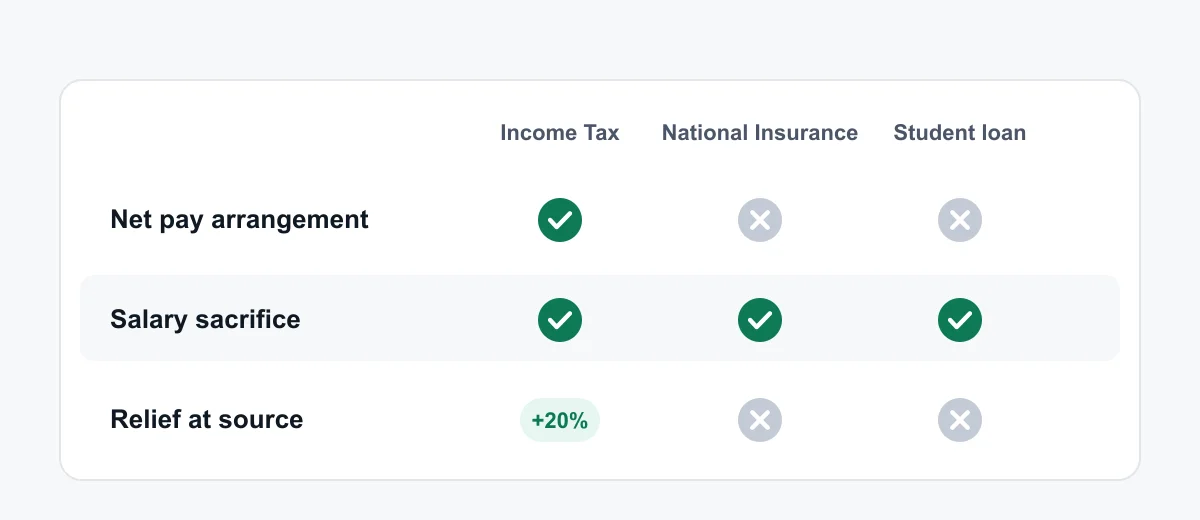
- Net pay arrangement: taken before Income Tax, so you get tax relief straight away. You still pay National Insurance on it.
- Salary sacrifice: you give up that part of your salary, so it reduces Income Tax, National Insurance and student loan repayments.
- Relief at source: taken from your pay after tax. Your pension provider then claims 20% basic-rate tax relief and adds it to your pot.
Student loan repayments
If you have a student loan, repayments come out through PAYE once your income passes your plan's threshold. For 2026/27:
| Plan | Threshold (per year) | Rate |
|---|---|---|
| Plan 1 | £26,900 | 9% |
| Plan 2 | £29,385 | 9% |
| Plan 4 (Scotland) | £33,795 | 9% |
| Plan 5 | £25,000 | 9% |
| Postgraduate Loan | £21,000 | 6% |
If you have a Postgraduate Loan as well as an undergraduate plan, you repay both at the same time.
A worked example
Take an employee in England earning £36,000 a year, paid monthly. They have tax code 1257L, pay 5% of salary into a workplace pension through a net pay arrangement, and have a Plan 2 student loan.
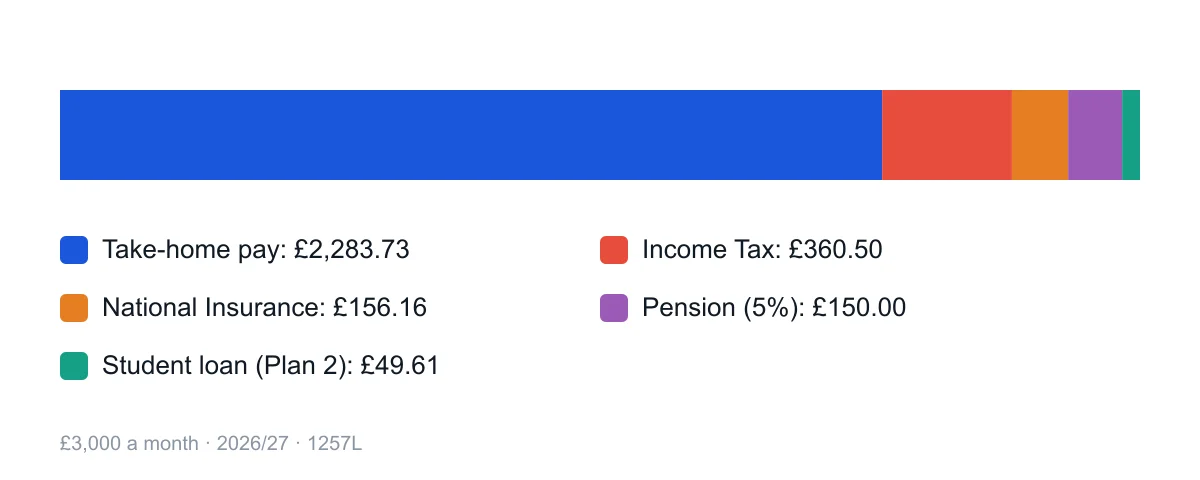
| Line | Amount |
|---|---|
| Gross pay | £3,000.00 |
| Pension (5%, before tax) | −£150.00 |
| Income Tax | −£360.50 |
| National Insurance | −£156.16 |
| Student loan (Plan 2) | −£49.61 |
| Net pay | £2,283.73 |
Here is how each line is worked out:
- Pension: 5% of £3,000 = £150.
- Income Tax: pay after pension is £2,850. Take off the monthly allowance of £1,047.50, leaving £1,802.50 taxed at 20% = £360.50.
- National Insurance: 8% of (£3,000 − £1,048) = £156.16.
- Student loan: 9% of the pay above the monthly Plan 2 threshold of £2,448.75 = £49.61. Real payslips round this down to the nearest pound.
The £150 pension contribution is not lost. It is saved in the employee's own pension pot, with their employer's contribution added on top.
How to estimate your own net pay
The quickest way is to use our UK salary calculator, which handles tax codes, Scotland, pension types and student loans. To check a payslip by hand:
- Start with gross pay for one pay period.
- Take off pension contributions made before tax.
- Work out Income Tax on what is left above your tax-free allowance for the period.
- Work out National Insurance on your pay above the period threshold.
- Take off student loan repayments and any other deductions.
If your take-home pay changes without warning, compare each deduction line with an earlier payslip. The usual causes are a new tax code, a change to your pension contribution, or a bonus pushing more of your pay into a higher band that month.
Sources
About Harry Thompson
UK Tax Accountant
Harry Thompson is a UK tax professional with experience in accounting, taxation and financial reporting. He writes the Monthly Salary Calculator UK and its salary guides.
More about Harry Thompson